
Choosing the right dental simulator is an important decision for dental universities, colleges, training centers and laboratories.
A dental simulation system is more than just a phantom head and a practice unit. It directly affects how students learn clinical procedures, how efficiently a classroom uses its available space and how much a school invests in its training facilities.
Today, dental education is placing increasing emphasis on practical training. Students need to practice hand positioning, instrument operation, tooth preparation and other clinical procedures before working with real patients. A well-designed dental simulator can help create a training environment that is closer to real clinical practice while allowing students to repeat procedures safely.
However, not every dental school needs the same type of simulation system.
Some institutions have limited classroom space. Others need to train a large number of students at the same time. Some schools prefer a cost-effective manual system, while others require a more advanced electric simulation center.
So, how do you choose the right dental simulator?
This guide will help you compare the most important factors before purchasing a dental training simulation system.
1. Start with Your Teaching Requirements
Before comparing technical specifications, the first question should be:
What kind of training will students perform on the dental simulator?
Different training programs may require different levels of equipment.
A basic pre-clinical training program may focus on:
- Tooth preparation
- Handpiece operation
- Dental instrument handling
- Phantom head practice
- False tooth restoration
- Basic clinical positioning
More advanced training environments may also require:
- Integrated electric control
- LED operating lights
- Multimedia teaching
- More realistic clinical simulation
- Better integration between the training table and simulator unit
The more closely the simulator needs to reproduce a real dental treatment environment, the more important the configuration and integration become.
For example, a compact manual simulator may be sufficient for basic student practice, while a large dental university may prefer an electric simulation center for a more comprehensive teaching environment.
Therefore, schools should first define their training objectives before selecting a model.
2. Consider the Number of Students You Need to Train
One of the most important factors when choosing a dental simulator is classroom capacity.
Dental schools often need to answer the following questions:
- How many students will use the training room?
- Will every student need an individual simulator?
- Can two students share one workstation?
- How many classes will operate each day?
The answer can significantly influence both the equipment selection and the total project cost.
Individual Training Systems
Individual simulation systems allow each student to have their own dedicated working area.
This approach is suitable for schools that want students to practice independently and have more control over their personal training environment.
For example, a compact manual dental simulator can provide a practical solution for individual student training while reducing the amount of space required for each workstation.
This type of system can be particularly useful for institutions that want to maximize the number of training stations in a limited classroom.
Shared Training Systems
For larger dental schools, a shared workstation can sometimes provide a more efficient solution.
A two-student dental simulation table allows students to practice from both sides of the same workstation.
This can help schools:
- Increase student capacity
- Improve classroom space utilization
- Reduce the number of individual tables required
- Potentially reduce transportation and installation costs
For institutions planning a large dental simulation laboratory, the number of students per workstation should be considered early in the project design.
3. Evaluate Your Available Classroom Space
Classroom space is often one of the biggest challenges when building a dental simulation center.
A simulator may look compact when viewed individually, but a complete classroom must also include enough room for:
- Students
- Dentist stools
- Instructor movement
- Walking aisles
- Equipment maintenance
- Emergency access
Therefore, the total footprint of the training system is just as important as the equipment itself.
Before purchasing, schools should prepare a classroom layout that includes:
- Number of simulation stations
- Space required for each student
- Table dimensions
- Chair and stool movement
- Distance between workstations
- Main walking aisles
A compact dental simulator can be particularly useful when classroom space is limited.
On the other hand, a larger integrated electric simulation center may require more planning but can provide a more complete training environment.
The best solution is not necessarily the smallest system or the most advanced system.
It is the system that provides the best balance between student capacity, training quality and available space.
4. Manual or Electric Control: Which Is Better?
Dental simulators generally vary in their control systems.
The right choice depends on the school’s teaching requirements, budget and expected training experience.
Manual Dental Simulator
A manual simulation system is generally a practical choice for schools looking for a simple and cost-effective training solution.
Its main advantages may include:
- Lower equipment complexity
- Easier operation
- Compact design
- Lower initial investment
- Suitable for basic dental training
- Easy classroom deployment
Manual systems can be a particularly good option for dental colleges, training centers and institutions that want to build a larger number of training stations within a controlled budget.
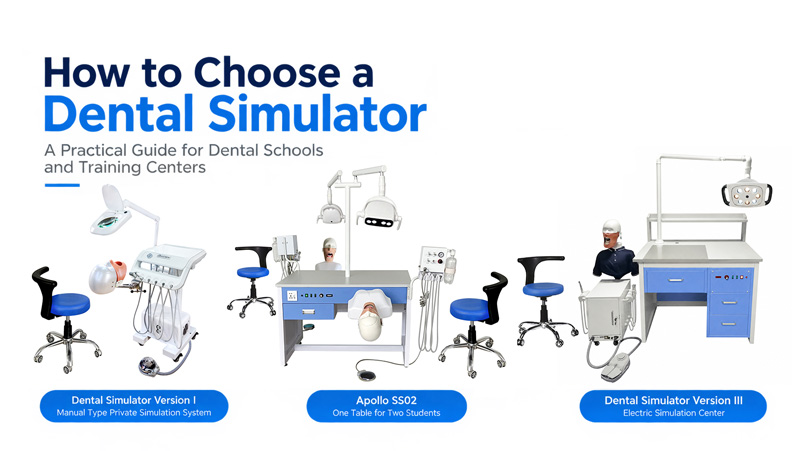
For example, the Dental Simulator Version I Manual Type Private Simulation System is designed as a compact solution for student practice.
Its portable design can help institutions save classroom space and potentially increase the number of simulation stations installed in one training room.
It can also be suitable for students who require additional practice outside the main classroom environment.
Electric Dental Simulator
An electric simulation system provides a more integrated and advanced training experience.
Depending on the configuration, an electric simulation center can integrate equipment such as:
- Phantom head
- Dental training unit
- Laboratory table
- LED sensor light
- Electric control system
This type of configuration can create a training environment that more closely resembles a real clinical workspace.
Electric simulation systems are particularly suitable for:
- Dental universities
- Large dental colleges
- Professional training centers
- Advanced pre-clinical laboratories
- Institutions focusing on multimedia education
The Dental Simulator Version III Electric Simulation Center is designed for institutions that require a more integrated dental training environment.
For schools planning long-term investment in a professional simulation laboratory, an electric system can provide a higher level of equipment integration and teaching functionality.
5. Decide Whether One Table Should Serve One or Two Students
Another important purchasing decision is the number of students assigned to each workstation.
A traditional approach may use one simulator for one student.
However, for large dental schools, a two-student simulation table can offer significant advantages.
The Apollo SS02 Dental Training Simulation System is designed to allow students to practice from both sides of the same workstation.
This design can help institutions improve the efficiency of classroom space.
Potential advantages include:
- Two students can practice at one table
- Better use of laboratory space
- Reduced number of tables required
- Easier classroom layout planning
- Potential savings in transportation and installation
This type of system can be particularly useful for universities that need to install a large number of training positions.
When comparing one-student and two-student systems, the decision should not be based only on the equipment price.
Schools should also compare:
- Total classroom capacity
- Floor space required per student
- Installation cost
- Shipping volume
- Future expansion requirements
In many large projects, the total cost per student workstation can be more important than the price of an individual simulator.
6. Look at the Realism of the Training Experience
The purpose of a dental simulator is to help students develop practical skills before clinical treatment.
Therefore, the realism of the working environment should be carefully considered.
Important elements may include:
Phantom Head Positioning
The phantom head should allow students to practice in a position that is reasonably similar to clinical dental treatment.
Students need to develop correct habits for:
- Sitting posture
- Hand positioning
- Instrument control
- Viewing angles
- Patient positioning
A good simulation system should support practical and repeatable training.
Working Light
Proper illumination is important during dental procedures.
An integrated LED operating light can help students practice under conditions closer to a real clinical environment.
Dental Unit Configuration
Depending on the training requirements, students may need access to instruments and controls similar to those used in clinical practice.
A more integrated training unit can help students become familiar with the workflow of dental treatment before entering a clinical environment.
The required level of realism should depend on the school’s curriculum.
Basic training programs may prioritize simplicity and capacity, while advanced programs may prioritize clinical simulation.
7. Consider Multimedia and Modern Teaching Methods
Modern dental education is increasingly combining traditional instruction with multimedia teaching.
Instructors may use:
- Demonstration videos
- Digital presentations
- Camera systems
- Live demonstrations
- Group instruction
For schools using multimedia classrooms, an integrated dental simulation center may provide a better foundation for combining practical training with modern teaching methods.
For example, an electric simulation center designed for multimedia education can be more suitable for institutions that want to create a complete pre-clinical training laboratory.
However, not every school requires the same level of multimedia integration.
Institutions should avoid paying for unnecessary features.
The goal should be to select equipment that matches the actual teaching method used by the school.
8. Compare Cost Based on the Total Project, Not Just One Unit
One of the most common mistakes when purchasing dental simulators is comparing only the price of one machine.
For a dental school project, the total investment may include:
- Dental simulators
- Laboratory tables
- Dentist stools
- Phantom heads
- Training units
- Operating lights
- Installation
- Shipping
- Classroom renovation
Therefore, schools should compare the total project cost per student.
For example, a lower-cost individual simulator may require more tables and more classroom space.
A two-student system may have a higher workstation price but reduce the total number of tables required.
Similarly, an advanced electric system may require a larger initial investment but provide more integrated teaching functionality.
The best purchasing decision should consider the long-term value of the complete training project.
9. Check Installation, Maintenance and Future Expansion
Dental schools should also think beyond the initial purchase.
Before choosing a dental simulator, ask the supplier:
- How easy is the installation?
- What utilities are required?
- Is maintenance simple?
- Are spare parts available?
- Can the system be expanded in the future?
- Can additional stations be added later?
- Is technical support available?
For large university projects, future expansion can be particularly important.
A school may initially install 20 or 30 simulation stations and later expand the laboratory.
Choosing a scalable system can make future upgrades easier.
Comparing the Three Main Types of Dental Simulators
The following comparison can help schools understand which type of dental simulator may be suitable for different applications.
| Type of Dental Simulator | Best For | Main Advantage |
|---|---|---|
| Manual Individual Simulator | Small classrooms, basic training, cost-sensitive projects | Compact, practical and cost-effective |
| Two-Student Simulation System | Large universities and high student capacity | Two students can practice at one table |
| Electric Simulation Center | Advanced dental schools and professional training centers | Integrated electric control and more complete training environment |
Based on Lingchen Dental’s current simulator range, institutions can choose between a manual individual system, a two-student shared workstation or a more integrated electric simulation center depending on their teaching requirements.
Which Dental Simulator Is Right for Your School?
Choose a Manual Dental Simulator If:
You want:
- A cost-effective solution
- Individual student practice
- Compact equipment
- Easy deployment
- Basic dental training capability
- Better use of limited classroom space
A manual individual simulator can be a practical starting point for many dental training programs.
Choose a Two-Student Simulation System If:
You want:
- Higher student capacity
- Better classroom space utilization
- Two students practicing at one workstation
- A practical solution for large universities
- More efficient laboratory planning
This option can be particularly attractive for institutions building a large dental simulation classroom.
Choose an Electric Simulation Center If:
You want:
- More advanced equipment integration
- Electric control
- A complete training workstation
- LED lighting
- Multimedia teaching compatibility
- A training environment closer to clinical practice
An electric simulation center can be a better choice for institutions building a modern and professional pre-clinical laboratory.
Final Thoughts: Choose Based on Your Teaching Model
There is no single “best” dental simulator for every university or training center.
The right choice depends on how your institution teaches, how many students need to practice and how much space is available.
Before making a purchasing decision, focus on these five questions:
- How many students need to train at the same time?
- How much classroom space is available?
- Do students need individual or shared workstations?
- Is a manual system sufficient, or is electric control required?
- What is the total project cost per student workstation?
By answering these questions first, dental schools can avoid overinvesting in unnecessary equipment while building a simulation laboratory that supports long-term education goals.
Whether you need a compact manual simulator, a two-student training system or an advanced electric simulation center, the most important goal is the same:
Create a practical, efficient and scalable environment where dental students can build clinical skills with confidence before treating real patients.
To explore different dental training simulation solutions, you can compare the available models on the Lingchen Dental Dental Simulators page.
Post time: Sep-08-2026