
Dental imaging has entered a new era. Traditional 2D dental X-rays provide valuable diagnostic information, but modern dentistry increasingly requires accurate three-dimensional visualization of anatomical structures.
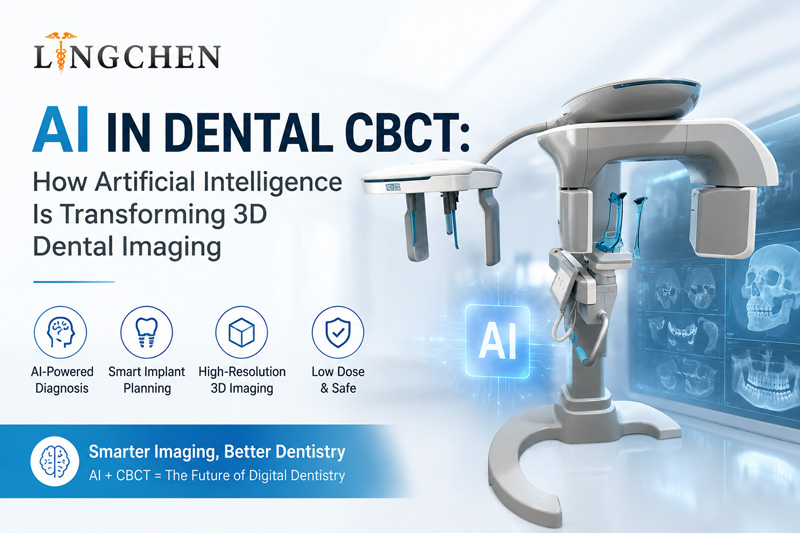
With the development of artificial intelligence (AI), Dental CBCT (Cone Beam Computed Tomography) is becoming smarter, faster, and more efficient. AI-powered CBCT systems help dentists analyze complex structures, improve implant planning accuracy, and create a more predictable digital dentistry workflow.
For dental clinics, universities, and imaging centers, choosing a CBCT machine with AI capabilities is no longer only about image resolution. It is about how intelligent technology can support better clinical decisions.
What Is AI in Dental CBCT?
AI in dental CBCT refers to the application of artificial intelligence algorithms, especially deep learning technology, to analyze and process 3D dental images.
Unlike traditional CBCT imaging, which mainly provides raw 3D data, AI-enabled CBCT systems can assist dentists by automatically identifying important anatomical structures and improving workflow efficiency.
AI technology can help with:
- Automatic tooth recognition
- Bone structure analysis
- Nerve canal identification
- Implant position planning
- Airway analysis
- Image enhancement
- Clinical measurement assistance
By combining CBCT with AI, dentists can obtain more meaningful diagnostic information from complex 3D images.
How AI Improves Dental CBCT Diagnosis
1. Automatic Anatomical Structure Recognition
One of the biggest advantages of AI CBCT technology is automatic recognition of important anatomical structures.
During implant surgery or oral surgery planning, dentists need to evaluate:
- Inferior alveolar nerve location
- Maxillary sinus position
- Bone height and width
- Root morphology
- Impacted teeth
AI algorithms can assist in identifying these structures, reducing manual analysis time and helping dentists make more accurate treatment plans.
2. AI-Assisted Dental Implant Planning
Dental implantology is one of the most important applications of CBCT.
Before implant surgery, dentists need accurate information about:
- Available bone volume
- Bone density
- Implant placement angle
- Distance from nerves and sinus cavities
AI-powered CBCT systems can support implant planning by analyzing 3D anatomical data and providing a clearer visualization of the surgical area.
The workflow becomes:
CBCT Scan
↓
AI Image Analysis
↓
3D Implant Planning
↓
Guided Surgery
This digital workflow improves predictability and reduces surgical risks.
3. Faster and More Efficient Clinical Workflow
Modern dental clinics face increasing patient numbers and complex cases. AI helps dentists save valuable time by reducing repetitive image analysis tasks.
Traditional workflow:
CBCT scan → Manual measurement → Manual structure identification → Treatment planning
AI-assisted workflow:
CBCT scan → AI analysis → Automatic measurements → Clinical decision support
For dental hospitals, universities, and multi-chair clinics, improving efficiency is a key factor when selecting a CBCT imaging system.
4. AI in Orthodontic Diagnosis
Orthodontic treatment requires detailed evaluation of facial structures, teeth position, airway conditions, and skeletal relationships.
AI-assisted CBCT can support:
- CEPH analysis
- Airway volume measurement
- Impacted tooth evaluation
- Root position analysis
- Facial structure assessment
Compared with traditional 2D imaging, CBCT provides three-dimensional information that helps orthodontists create more comprehensive treatment plans.
5. Improving CBCT Image Quality with AI
Image quality is one of the most important factors in dental imaging.
AI technology can help optimize CBCT images by:
- Reducing image noise
- Improving visualization of fine structures
- Enhancing contrast
- Supporting low-dose imaging
This is especially important for applications requiring high detail, such as:
- Endodontics
- Implant dentistry
- Oral surgery
Why Dental Clinics Should Choose an AI-Ready CBCT System
When purchasing a dental CBCT machine, clinics should consider more than scanning specifications.
Important features include:
1. High Resolution Imaging
A smaller voxel size provides clearer visualization of small anatomical structures.
Important for:
- Root canal treatment
- Implant planning
- Periodontal evaluation
2. Flexible Field of View (FOV)
Different clinical applications require different scanning areas.
Small FOV:
- Endodontics
- Single tooth diagnosis
Medium FOV:
- Implant dentistry
Large FOV:
- Orthodontics
- Maxillofacial analysis
3. Advanced Software Support
A modern CBCT system should provide:
- 3D reconstruction
- Implant planning tools
- CEPH analysis
- Airway analysis
- AI-assisted diagnosis
4. Low Radiation Dose Technology
Patient safety remains a priority.
A good CBCT system should balance:
- Image quality
- Radiation dose
- Scan speed
The Future of AI and CBCT in Digital Dentistry
The future of dental imaging is moving toward a fully connected digital workflow.
AI-powered CBCT will continue integrating with:
- Intraoral scanners
- CAD/CAM systems
- Implant planning software
- Digital smile design
- Guided surgery systems
The combination of CBCT + AI + Digital Dentistry will help dentists provide more accurate, efficient, and personalized treatment.
How to Choose the Right AI Dental CBCT Machine?
Before investing in a CBCT system, dental professionals should evaluate:
✔ Image resolution
✔ Detector technology
✔ FOV options
✔ AI-assisted software features
✔ Implant planning capability
✔ Radiation safety
✔ After-sales support
A reliable CBCT machine should not only capture images but also help dentists transform imaging data into clinical solutions.
Conclusion
AI is changing the role of CBCT in modern dentistry. From implant planning and orthodontic diagnosis to oral surgery and digital workflows, artificial intelligence makes 3D dental imaging smarter and more efficient.
For dental clinics, universities, and distributors looking for advanced imaging solutions, an AI-ready dental CBCT system represents the future direction of digital dentistry.
FAQ
Q1: What is AI dental CBCT?
AI dental CBCT combines cone beam computed tomography with artificial intelligence algorithms to improve image analysis, diagnosis, and treatment planning.
Q2: How does AI improve CBCT imaging?
AI helps dentists automatically identify anatomical structures, improve image quality, and support faster treatment planning.
Q3: Is CBCT better than traditional dental X-ray?
CBCT provides 3D images, allowing dentists to evaluate bone structures, nerves, and anatomical details that cannot be seen clearly with 2D X-rays.
Q4: Why is CBCT important for dental implant planning?
CBCT provides accurate information about bone volume, nerve location, and implant positioning before surgery.
Post time: Aug-21-2026