
A dental microscope is more than a magnification device. For endodontics, oral surgery, and other precision procedures, the right microscope can improve visibility, working accuracy, and operator comfort.
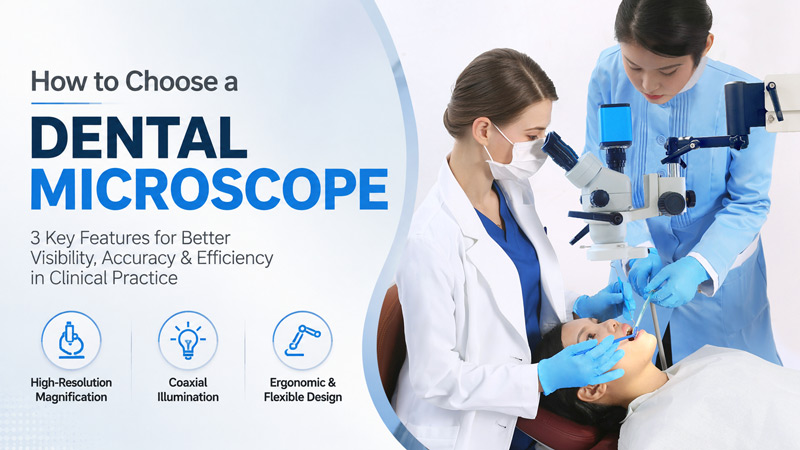
When choosing a dental operating microscope, there are three key areas to consider: optical magnification, coaxial illumination, and ergonomic stability.
1. High-Resolution Optical Magnification
The optical system is the core of a dental microscope. A professional system should provide continuous magnification, such as 6×–30×, together with a large depth of field and APO (apochromatic) optical correction.
High optical resolution helps clinicians identify structures that are difficult or impossible to see with the naked eye, including:
- Root canal branches
- Calcifications
- Dentin cracks
- Small anatomical structures
- Missed orifices and accessory canals
A resolution of ≥100 lp/mm can provide clear visualization of fine details, helping dentists locate complex anatomy more accurately and reduce the risk of treatment errors.
2. Professional Cold Coaxial Illumination
Magnification is only useful when the treatment area is properly illuminated. A professional dental microscope should combine high-intensity illumination with coaxial lighting.
A suitable light source typically provides a 5000–6000K color temperature and high brightness, such as ≥80,000 lux. LED or xenon light sources can provide strong illumination while minimizing unnecessary heat.
The biggest advantage of coaxial illumination is that the light follows the same optical path as the clinician’s line of sight. This helps reduce shadows and illuminate difficult areas such as deep root canals, narrow cavities, and the bottom of the pulp chamber.
A professional filter system can further improve visualization by enhancing contrast and making specific clinical structures easier to distinguish.
3. Stable and Flexible Ergonomic Design
A dental microscope is often used during long and demanding procedures, so mechanical stability and ergonomics are just as important as optical performance.
Features worth considering include:
- 360° movement joints
- Electric or hydraulic balancing
- Adjustable binocular tubes
- More than 180° binocular inclination
- Adjustable working distance, typically around 200–300 mm
- Anti-vibration design
These features allow dentists to adjust the microscope according to different treatment positions while maintaining a comfortable posture. Flexible positioning can also leave sufficient space for four-handed dentistry, helping the dentist and assistant work efficiently together.
Final Thoughts
Choosing a dental microscope should not be based on magnification alone. A truly clinical-focused system should combine high-resolution optics, powerful coaxial illumination, and stable ergonomic movement.
For endodontic procedures especially, these three elements work together to provide a clearer view of complex anatomy, improve precision, and make long procedures more comfortable.
In short: better magnification shows the detail, better illumination reveals the detail, and better ergonomics help you work on the detail with greater control.
Post time: Aug-18-2026