
Dental handpieces—commonly known as dental drills—are essential tools in modern dentistry. They enable dentists to remove decay, shape tooth structures, polish restorations, and perform various clinical procedures with precision. Although they may appear simple from the outside, dental handpieces incorporate sophisticated engineering. This article explains how dental handpieces work, their main components, and the differences between various types.
1. Basic Principle of Operation
At the core, a dental handpiece converts energy (air pressure or electricity) into high-speed rotational motion used to spin cutting instruments called burs. This rotational movement allows dentists to cut enamel, dentin, or prosthetic materials efficiently and safely.
Depending on the model, the handpiece may operate at speeds ranging from:
-
High-speed handpieces: 200,000–450,000 rpm
-
Low-speed handpieces: 5,000–40,000 rpm
2. Main Components of a Dental Handpiece
1. Power Source
Dental handpieces generally use:
-
Air-driven turbines
Powered by compressed air delivered through the dental unit. Air spins a small turbine rotor, creating high speed. -
Electric motors
Use an electric micromotor to provide consistent torque at various speeds.
2. Turbine or Motor
-
Air-turbine handpieces contain a rotor with blades. When air flows through, the rotor spins rapidly.
-
Electric handpieces use a miniature motor that directly rotates the bur.
3. Head and Chuck System
This is the section where the bur is held.
The chuck mechanism (push-button or wrench type) secures the bur firmly during operation.
4. Bearings
High-precision ceramic or steel bearings support the turbine’s rotation, reducing friction and ensuring smooth spinning at very high speeds.
5. Cooling and Water Spray
To prevent overheating and protect tissues, a water spray system cools the tooth surface during cutting.
High-speed handpieces often feature a triple-spray or multi-spray design for effective cooling.
6. Fiber Optic or LED Light
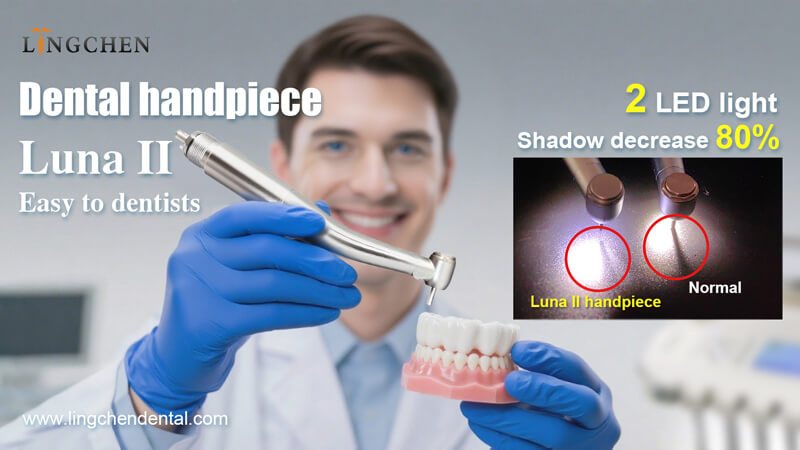
Modern handpieces often include built-in illumination, providing a clear view of the working area.
3. How High-Speed Handpieces Work
High-speed handpieces rely mostly on air-turbine power:
-
Compressed air enters the handpiece through the air tube.
-
Air hits the turbine blades, causing the rotor to spin.
-
The rotor’s shaft is connected to the bur, which rotates at extremely high speeds.
-
Water spray cools the bur and tooth surface.
-
Exhaust air exits through designated channels.
Advantages:
-
Extremely high speeds
-
Lightweight and small head design
-
Smooth cutting efficiency
Limitations:
-
Lower torque compared to electric systems
-
Can stall under heavy pressure
4. How Low-Speed Handpieces Work
Low-speed handpieces typically use electric motors or air-powered motors.
Instead of a turbine, they rely on gear systems to transmit rotational motion.
Used for:
-
Polishing
-
Finishing
-
Caries removal
-
Adjusting removable dentures
They provide higher torque but lower speed, making them ideal for fine and delicate tasks.
5. Maintenance and Longevity
Proper maintenance ensures handpiece performance and durability. This includes:
-
Lubrication before sterilization
-
Cleaning internal components
-
Sterilization in an autoclave
-
Regular replacement of bearings and O-rings
Well-maintained handpieces ensure smoother operation, longer lifespan, and better patient comfort.
Dental handpieces are an indispensable part of modern dentistry, combining advanced mechanical engineering with practical functionality. Whether air-driven or electric, high-speed or low-speed, their purpose remains the same: to help dentists perform precise, efficient, and safe dental procedures. Understanding how they work provides valuable insight into the complexity behind a tool many patients see but rarely understand.
Post time: Dec-05-2025